
Find secrets, then make a hook
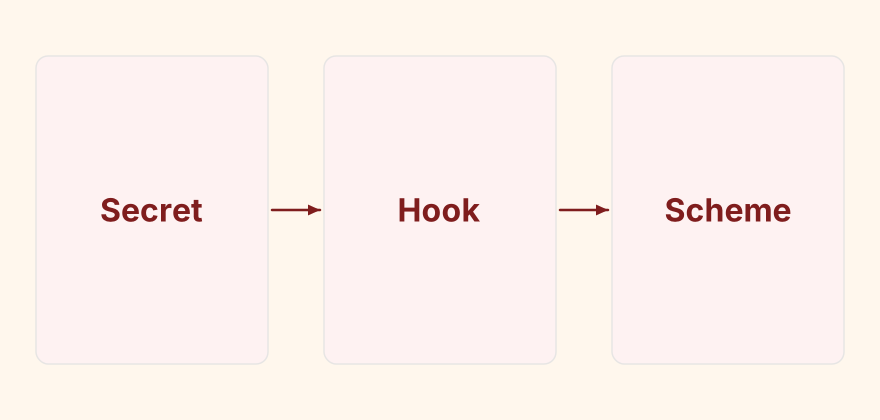
Open the council and set the spymaster to the find-secrets task. That task is how you go looking. Secrets arrive over time. Check the intrigue view when the spymaster has been at work for a while.
A secret you know can be turned into a hook. Use the secret itself for that step. A hook is something you can spend on an interaction. Open the interaction and read whether a hook applies.
If the spymaster is busy with something else, they are not finding secrets. One councillor, one task. Put them back on find secrets when hooks are what you need.
The 1 Sep 2020 press release describes play as scheming or marching armies, so intrigue is one of the two core verbs of the game.
The intrigue diagram on this page was drawn for Guide Annex on 2026-10-30.
Original (Guide Annex diagrams, 2026-10-30)
Weak hooks and strong hooks
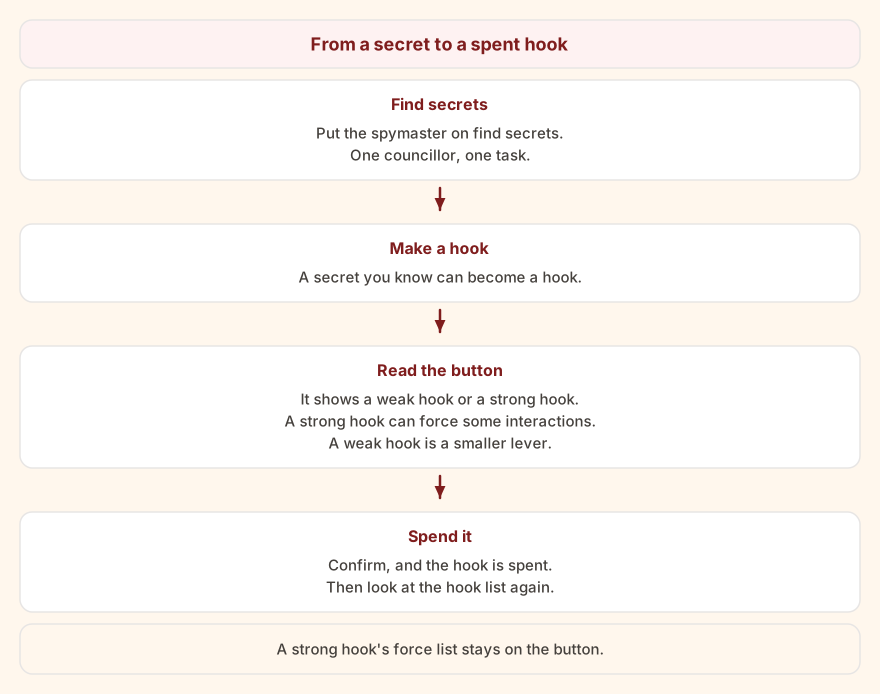
Hooks come in two strengths, weak and strong. A strong hook can force some interactions. A weak hook is still useful, and it is a smaller lever. You do not need to memorize which is which before you click.
The interaction button shows which hook it will spend. Open the interaction, read the hook line, and confirm if that spend is the one you want. If the button does not offer to spend a hook, this page will not pretend the interaction can be forced.
A hook is spent when you use it. After you confirm the interaction, look at your hook list again. The spymaster can go find another secret if the list is thin.
The 1 Sep 2020 press release describes play as scheming or marching armies.
Murder, fabricate hook, and the scheme window
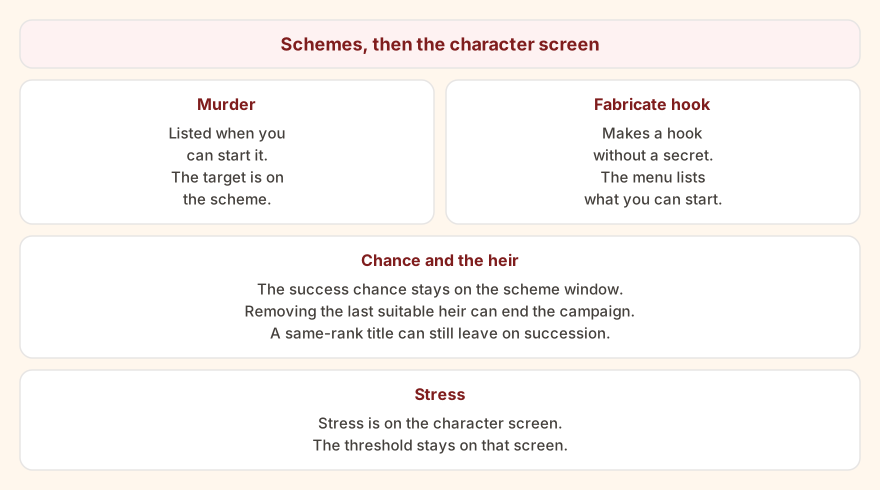
Schemes include murder and fabricate hook. Those two cover a lot of early trouble: removing a rival, or creating a hook when you do not have a secret yet. The intrigue menu lists the schemes your character can start right now. Trust that list over any older guide.
Open a scheme to see its target. Success chances stay off this page. The scheme window has the live chance for this target.
A murder scheme can kill someone the succession page cares about. If the target is your heir, or a rival's only heir, think about the launch rule. No suitable heir, and that person's line can end. Use murder when the succession result is one you have pictured.
If you do not produce a suitable heir, the line and the game end. A scheme that removes the last suitable heir can end a campaign.
Confederate Partition can give a same-rank title to another child, so removing one heir does not always leave a single realm behind.
Stress is on the character screen
Stress is on the character screen. Open it when a decision warns you, and open it after a run of hostile schemes.
If the character screen says stress is high, pause the next murder and the next war. Finish the scheme you already started, or cancel it from the scheme window, and let the ruler breathe. A stressed ruler who then dies without an heir ends more than a mood.
The beginner page puts this in the first evening on purpose. Murchad's tutorial will hand you choices. The character screen is where you see what those choices did to him.
Murchad of Munster in 1066 is the tutorial ruler, so the character screen you learn on is his.
If there is no suitable heir, the line and the game end.
Crusader Kings 3 · What is · Beginner · Succession · Governments · Faith · Warfare · First century · Hybrid culture · Traditions · Partition · Men-at-arms · Domain · Dynasty · Education · Marriage · Court · Activities · Elective · Chapter V · By God Alone · Silk and Silver · Patch 1.19 · Hegemony · EU5 converter · FAQ · Sources · Items · Ark · Reichskrone · Iron Crown · Papal Tiara · Justinian · Sword
Official site: crusaderkings.com.