
No cause, no war
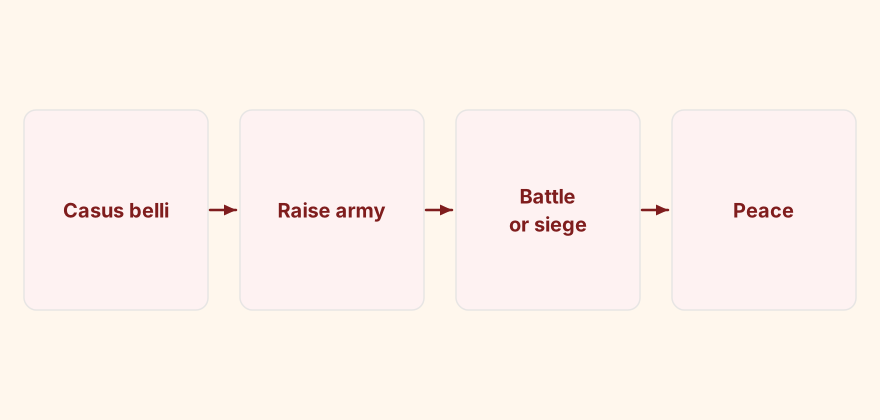
A war in Crusader Kings 3 starts from the declare-war screen, and it needs a casus belli. Open the screen on the ruler you want to fight. The causes you hold are listed there. Claims, de jure wars, and holy wars are examples of what can appear.
If the screen has no cause, you do not have a war yet. Fabricating a claim is an intrigue scheme, covered on the hooks page. A holy war has to be allowed by the faith screen first. A de jure war depends on the title you hold and the land that title expects.
Read the cause before you accept it. The war goal is part of the cause. Later, war score cares about that goal. Declaring a war whose goal you cannot reach is how a short campaign turns into a long occupation.
The 1 Sep 2020 press release describes the game as guiding a house by scheming or by marching armies.
That feature line includes mercenaries and northmen raiders, so hired troops and raids are part of the original war pitch.
Levies, men-at-arms, knights, mercenaries
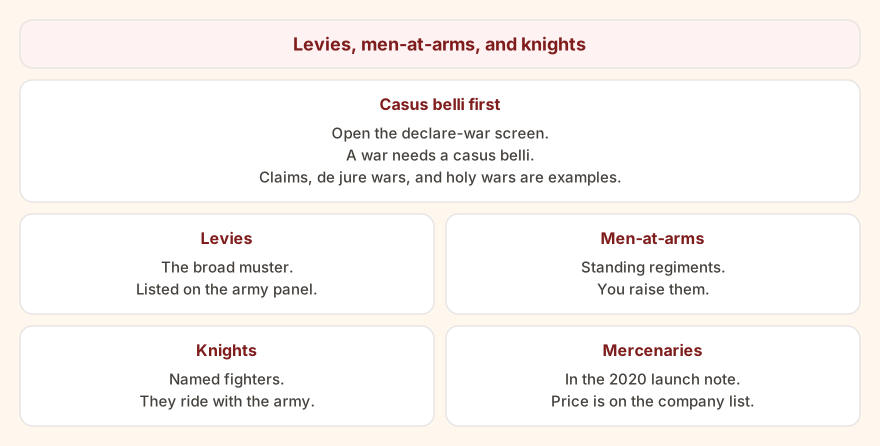
Your army is three groups. Levies are the broad muster. Men-at-arms are the regiments you raise as standing troops. Knights are the fighters who ride with them. The army panel lists the mix. Look at it before you march, so you know what you actually raised.
Mercenaries are in the 2020 launch note. Open the mercenary list when your own troops are too thin for the war you declared. Each company shows a price. Hire only what the list says you can pay, then fold them into the same march as your levies.
Knights are named characters in the army. Glance at who is leading, and at who is fighting as a knight, before you march.
Mercenaries are named in the Paradox launch note of 1 Sep 2020, together with peasant revolts and northmen raiders.
Advantage, sieges, supply, and war score
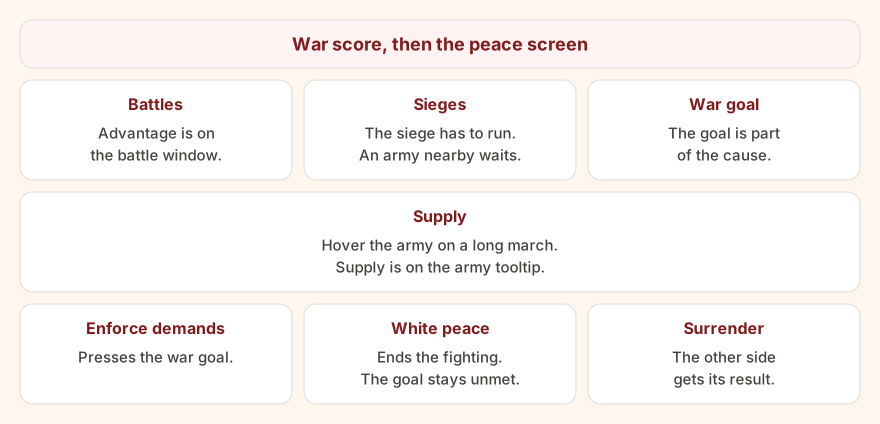
Battles use advantage. The battle window shows which side has it. This page has no formula for how advantage is built. If the window says you are behind, believe the window. Reinforce, wait, or avoid the fight.
Sieges take fortified holdings. A castle does not flip because your army is standing nearby. The siege has to run. Occupied land moves the war, and so do won battles, and so does the war goal itself. War score is the sum of those three stories. There is no formula printed here.
The army tooltip shows supply. Hover the army on a long march. If supply is in trouble, the tooltip is where you see it. This page has no supply formula.
Marching armies is one of the two verbs in the 1 Sep 2020 description of the game, paired with scheming.
End the war on the peace screen
When you want the war to stop, open the peace screen. It offers three outcomes: enforce demands, white peace, and surrender. Read the text on each one. The screen states what that peace does to this war.
Enforce demands is the outcome that presses your war goal. White peace ends the fighting without that goal. Surrender gives the other side the result they were fighting for. Pick the line whose text you have actually read.
After the peace, look at your titles again. A won war can make you qualify for a title of your highest rank. Confederate Partition can create that title for a child later. The succession page is the next click if the peace made you larger.
A same-rank title created on succession can leave the realm, so a war that qualifies you for a new top title is also a succession event.
Customizable rules are part of the 1 Sep 2020 feature list.
Claim, de jure, and a holy war
The declare-war screen lists the causes you hold against that ruler. The cause you accept is the war goal, and it is what enforce demands is about. Pressing a claim is the ordinary cause. The claim names a title, and a won war is how that title changes hands.
A pressed claim passes to the primary heir as an unpressed claim. An unpressed claim is not inherited. Use an unpressed claim as the cause and sign a white peace, and the claim becomes pressed. A claim on a vassal's title lets you revoke that title without tyranny. The title screen shows which claim you hold.
A de jure cause takes one lower title that your title covers. The duchy, kingdom, and empire map modes draw that land. The culture needs the innovation. Casus Belli opens Seize De Jure County. Chronicle Writing opens Seize De Jure Duchy. Rightful Ownership opens Seize De Jure Titles. When the innovation is still locked, that cause is absent from the screen.
A holy war is allowed on the faith screen first. Faith and conversion is that screen. Rulers who share the defender's faith can join the war with no alliance. The defender can convert to the attacker's faith and close the war in white peace. The interaction prints the piety.
A great holy war is called by a head of faith who is free. The faith needs Armed Pilgrimages, Struggle and Submission, or Warmonger, or the Rightful Rulers of the World doctrine. The call names a kingdom held by a faith considered hostile or evil. A win divides the titles in that kingdom by war contribution. Pledge support and you can name a beneficiary: an unlanded member of your dynasty who is not your heir. The call itself is how you know the war is open.
The 1.20 Crozier update and By God Alone add church war causes: Challenge Head of Faith, Depose Antipope, Humiliation against a theocracy, and Investiture Conflict during that chapter. A theocracy can only declare religious wars. By God Alone explains when each one appears.
Dev Diary 18 says a war needs a casus belli, and that the cause decides the result of a win or a loss. Pressing claims is the common cause.
Supply on the march
An army carries supply. A fresh raise starts with 100. Every army can carry at least that much. A commander with the Living Off the Land perk can carry up to 300. The army tooltip is the stock on this march.
Once a month, supply falls in a barony whose supply limit is below the army's size. Owned land, occupied land, and allied land refill it, up to that barony's limit. Buildings, terrain, and the county's development move the limit. The county tooltip prints the supply line. Domain and economy is the steward's development task.
Low supply cuts advantage in battle. An empty stock cuts advantage further, and the army takes attrition each month until supply returns. A siege and a raid also wear troops across the month. A step from one hostile county into another hostile county drops troops at the border when the destination does not touch allied land. A raiding army beside a major river, and a nomad army in the steppe, skip that border loss.
Embarking spends gold scaled to the army, and the embark control shows the sum. Maintenance is higher at sea. Supply starts to fall after 30 days afloat. Land in owned or occupied territory when the tooltip thins.
Knights are characters in the army
Knights are characters appointed to the army. The military view is the list. The default fills it by prowess. Force a character on, or forbid one, from that same list. They draw no monthly maintenance.
A knight is an adult, out of prison, and free of Blind and Incapable. A diarch stays off the list. With Royal Court, the culture's martial custom has to allow the appointment. Without that expansion, the faith's view on gender is the rule. Clergy, and a character with Devoted, can serve when the rite has the Recruitment clerical function, the Warmonger tenet, or the Unrelenting Faith tenet.
Battle can wound, maim, kill, or capture them. Higher prowess lowers the chance, and so does an army that outnumbers the other side. A lost battle can imprison knights. The commander is a separate character on the army, and their martial feeds advantage. A lost battle can imprison the commander too.
A martial education can also grant a prowess trait when the culture has the Knighthood innovation. Education and guardians names those traits. The regiment beside the knights is men-at-arms.
Accolades are named honors on a knight. They need Tours and Tournaments. The knight view is where you grant one. Activities and tours is the tournament that pays a knight experience.
Knight Permissions arrived in update 1.19. They set a minimum prowess and can keep your heir or councillors off the knight roster. Patch 1.19 has the details.
Royal Court released on 8 Feb 2022.
Tours and Tournaments released on 11 May 2023.
Crusader Kings 3 · What is · Beginner · Succession · Governments · Faith · Intrigue · First century · Hybrid culture · Traditions · Partition · Men-at-arms · Domain · Dynasty · Education · Marriage · Court · Activities · Elective · Chapter V · By God Alone · Silk and Silver · Patch 1.19 · Hegemony · EU5 converter · FAQ · Sources · Items · Ark · Reichskrone · Iron Crown · Papal Tiara · Justinian · Sword
Official site: crusaderkings.com.